


As an avid reader and a passionate writer, there are certain authors whose words resonate deeply within me, and for me, that author is undoubtedly Nora Roberts. Her work has not only entertained me but has also inspired my own creative journey in countless ways.

From the moment I picked up one of her novels, I was captivated by her ability to weave complex characters with rich, emotional narratives. Nora has an incredible knack for creating strong, multifaceted women who confront their fears, overcome obstacles, and embrace love in all its forms. These characters feel like friends, and their journeys mirror the struggles and triumphs we all face in our lives. It’s this relatability that draws me back to her books time and time again.
We both share similar ancestry. Nora Roberts, born Eleanor Marie Robertson, has a rich ancestry that traces back to Irish and Scottish roots. Her family history reflects a blend of cultures, which often influences her storytelling. Roberts has spoken about her Irish heritage and how it has inspired various elements in her novels, including themes of family, love, and a deep sense of place. Her background contributes to the strong, independent characters she creates, often drawing from her own experiences and the history of her ancestors. Nora’s ancestry plays a significant role in shaping her writing and the worlds she builds in her books.
What truly inspires me about Nora Roberts is her unwavering dedication to her craft. With over 200 published novels, she demonstrates what it means to be a prolific writer. Her work ethic is something I admire immensely. It reminds me that persistence and passion are key ingredients in achieving success. Nora has shown that writing is not just a talent but also a discipline that requires commitment and hard work. This motivates me to put pen to paper, even on days when inspiration feels fleeting.
Moreover, I appreciate how Nora infuses her stories with themes of empowerment and resilience. In her novels, love is not just a plot device; it’s a transformative force that enables her characters to find their true selves. This representation of love—be it romantic, familial, or platonic—encourages me to celebrate the relationships in my own life and to recognize their power in shaping who I am.
Nora Roberts also has a unique ability to blend genres, seamlessly transitioning from romance to suspense, mystery, and even fantasy. This versatility inspires me to explore different styles in my own writing. It has taught me that breaking out of my comfort zone can lead to the most rewarding creative experiences.
Finally, I find inspiration in Nora’s willingness to share her journey with her readers. Her candidness about her successes, failures, and the realities of being a writer provides a sense of community. It reassures me that I’m not alone in this often tumultuous path of creativity. Her story reminds me that every writer has their own unique journey, and it’s okay to embrace the highs and lows along the way.
Roberts is not just a favorite author who shares my sun sign of Libra; she is a beacon of inspiration for me. Her incredible storytelling, dedication to her craft, and the empowering messages woven through her narratives remind me why I fell in love with writing in the first place. I aspire to embody her passion, resilience, and creativity in my own work.
Love and magic have a great deal in common. They enrich the soul, delight the heart. And they both take practice.
I need to write to be happy.
I don’t think you can write – at least not well – if you don’t love stories, love the written word.
It’s her work ethic that really defines Roberts. She’s prodigious. A publishing sensation. By her own estimate, it takes her around 45 days to write a novel. And then she starts the next one.
“Sometimes the house has to be shovelled out so I sometimes have a day before I start the next one,” she says. “But not usually longer than that.”
“Whatever I’m doing, I get very guilty if I don’t put a good day’s work in. I’m not one for making excuses. I had this Catholic upbringing. I was taught to finish what you start.” She writes pretty much all day, every day.
Most importantly, she writes what she likes to read. And what’s so bad about a happy ending, she asks? “Romance gets disparaged for the happy endings. But all genres have expectations and all genres require narrative resolution. But it’s disparaged because it’s happy. And if it was important, it would be tragic. Which is bullshit. Look at Much Ado About Nothing – everybody is happy.”
What does she find helps keep her going when she’s writing? “Alcoholic beverages.”
Does she tweet? “I’d rather stab myself in the eye with a flaming stick.”
What does she think of the recent news story claiming that romantic fiction gives women unrealistic expectations? “Because women aren’t supposed to have expectations, right? We’re pretty smart. I think we know the difference between reality and fiction. I don’t think that people read Agatha Christie and then think: I know, I’ll go and murder someone.”
There is, she says, “more than a streak of misogyny in the way romance is viewed. All some people see is the big R and dismiss it. But I’ve made my career on my own terms and that doesn’t necessarily suit the likes of the New York Times book review.
“They don’t see that as legitimate. But it’s just so insulting towards millions of people. Why would you apologise for what you read for pleasure? Just think of the illiteracy rate. Every book read for pleasure should be celebrated. And novels that celebrate love, commitment, relationships, making relationships work, why isn’t that something to be respected?”
She was never ambitious and had no desire to have a career, nor any inkling that she would one day be a writer. “Although there was obviously something trying to get out,” she says. “Before I started writing, you name the craft, I did it. I made my own bread. I made my own jam. I needlepointed. I crocheted. I sewed all my boys’ clothes. I sewed my own clothes. I was looking for something. And it was writing. It fed something in me.”
Creating feisty heroines was something that came naturally to her. “I was, like, I don’t want to be the secretary, I want to be the boss. I didn’t want to write the kind of story where the man treats the woman like shit for the entire book and in the last chapter he tells her, ‘I treated you like shit because I love you’. That won’t do for me. Or for a lot of other writers. I started to write the kind of stories that I wanted to read. It was very instinctive. You just wanted the heroines to be a bit feisty.”
Most importantly, she writes what she likes to read. And what’s so bad about a happy ending, she asks? “Romance gets disparaged for the happy endings. But all genres have expectations and all genres require narrative resolution. But it’s disparaged because it’s happy. And if it was important, it would be tragic. Which is bullshit. Look at Much Ado About Nothing – everybody is happy.”
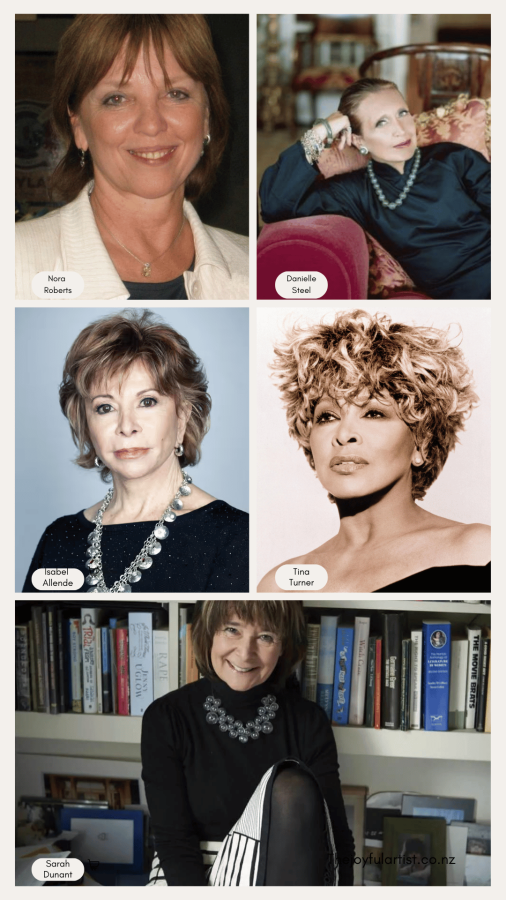
Here are a few of my other writing inspirations:
YOU MAY ALSO ENJOY:
Danielle Steel and the joy of working on many projects at the same time
#NoraRoberts #Inspiration #WritingCommunity #WomenInLiterature #Empowerment #BookLovers #CreativeJourney #MollieMathewsStyle