


People often like to know how writers write.
The habits. The rituals. The secret routines that somehow turn thought into story.
I know I do.
Lately, while living and writing in Panama, I’ve found myself fascinated by the daily rhythms of other writers—especially John le Carré. I’ve been reading The Tailor of Panama alongside his biography and letters, noticing how much attention he paid to when he wrote, how he rested, and why he walked. Morning writing. Then a walk. Then a drink. A life shaped around listening to the mind after it has worked.
It struck me how familiar that feels.
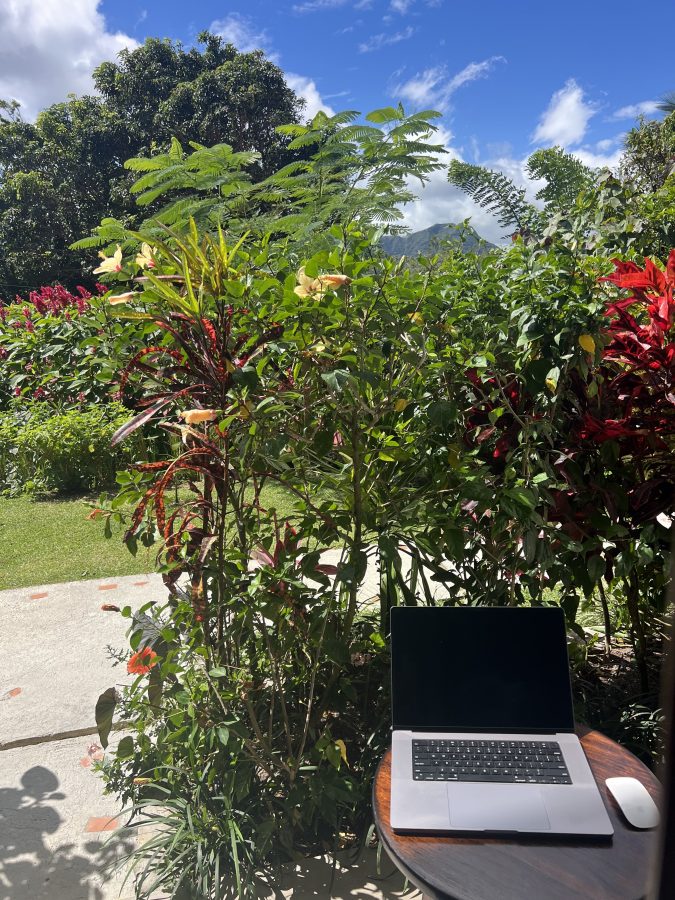
As I record this (dictating into my phone), it’s nearly four in the afternoon. I’m walking through the estate here in Valle Escondido, Boquete, breathing in the cool air that settles as the mist drapes itself over the mountains. The sky above is still clear, but the hills are slowly disappearing into grey and white. It’s quiet. Sacred, even.
I walk because it’s healthy—but more than that, I walk because ideas arrive there.
While writing Love in Panama, I was walking beside a river when I noticed a cluster of berries. I recognised them instantly from time spent on Finca Lerida: coffee cherries. That moment sparked an entire scene—one that became pivotal, tender, and quietly joyful. I won’t give it away, except to say it leads to a happily-ever-after and a beautiful surprise.
That’s how stories come to me.
Not through forcing—but through noticing.
I’d planned today to reward myself with a walk to a café by the river—a little ritual I sometimes use as motivation. But the place was so still, so peaceful, that I suddenly thought: why interrupt this?
Why trade silence for noise?
Why exchange presence for performance?
So I stayed home. I wrote. I filled my inspiration well instead.
I added scenes to Love in Panama (the prequel)—the full-length love story is called The Colour of Love—including a food scene inspired by the extraordinary meals we’ve eaten here. Panama is a true melting pot, and I wanted to honour that: food as bridge, as belonging, as celebration. A quiet counter-argument to the idea that immigrants somehow dilute culture, when in truth they enrich it—when held with care and balance.
One scene began simply because a Panamanian woman explained to us why the streets were bursting with people.
“New Year’s Day,” she said. “It’s very important here.”
And just like that, the scene found its anchor.
Years ago, in counselling training, I learned that people often need to hear themselves to heal. The counsellor’s job is to listen—to be a conduit, not a director.
Writing feels similar, but reversed.
The story is the counsellor.
The writing is the healer.
And I am the client.
I don’t plan my books rigidly. I allow them to lead me where they need to go. I trust the story’s intelligence—much like solution-focused therapy trusts that the client already carries the answer.
I may jump ahead to the ending, then return to fill in the middle. I write short, then ask:
What’s missing?
More setting? More emotion? More tension? More mystery?
Then I layer.
My process is fluid:
Handwriting, especially, feels ancient—connected to the heart, to intuition, to something older than the keyboard.
I read constantly. Not to copy—but to remember what’s possible.
Recently, I’ve been nourished by:
And alongside all of this, I’ve been re-reading Care of the Soul by Thomas Moore—a book that keeps reminding me that soul needs tending, not fixing.
Every day I like to set a one-sentence intention to guide the day. Today’s word for me was sacred.
The mist.
The quiet.
The full moon in Pisces still lingering in the air.
No machines. No urgency. Just presence.
I feel deeply grateful—to be a writer, to live this life, to send words out into the world. Recently, I set Love In Sicily to 99c, linking it to themes of hope and healing after tragedy. A psychologist wrote to thank me for how I handled survivor’s guilt.
Those messages matter.

Because in the end, we are all letters.
We are all pens—held, perhaps, in something greater than ourselves.
And sometimes, all it takes to write is to walk…
and listen.

I didn’t just write this prequel.
I lived it—slow mornings, bitter-sweet coffee, stories that asked to be told.
👉 Pour a cup. Start the story. The prequel is available now.
AMAZON
US: https://www.amazon.com/dp/B0GBN3ZSHJ
CA: https://www.amazon.ca/dp/B0GBN3ZSHJ
UK: https://www.amazon.co.uk/dp/B0GBN3ZSHJ
AU: https://www.amazon.com.au/dp/B0GBN3ZSHJ
IBOOKS, BARNES & NOBLE, KOBO and other great bookstores: